Warning on risks: Financial contracts for difference are complex instruments and are associated with a high risk of rapid financial losses due to leverage. On 77.44% of retail investor accounts, financial losses occur when trading financial contracts for difference with this provider. You should consider whether you understand how financial contracts for difference work, and whether you can afford to take the high risk of suffering financial losses. Please read the Risk Disclosures.


Travelers Companies: Profit Soared to $2.2 Billion, and the Insurance Company Rewarded Shareholders
Financial markets took notice when Travelers Companies released its second-quarter 2026 results, which significantly exceeded analysts’ expectations and signaled that the insurance sector may be entering an exceptionally strong period. A combination of favorable claims experience, rising investment returns, and disciplined risk pricing created conditions that had a more pronounced impact on the company’s results than many had anticipated. At the same time, this strong performance raised the question of whether this is merely a one-time effect or the beginning of a longer-term trend that could fundamentally impact the entire sector. [1]
About the company
The Travelers Companies, Inc. is a U.S.-based publicly traded insurance company headquartered in New York. The brand’s history dates back to 1853, and today it ranks among the leading providers of property and casualty insurance in the United States. The company offers auto, home, and business insurance, distributing its products primarily through independent insurance agents and brokers. Travelers operates in the United States and select international markets, employs more than 30,000 people, and reported revenue of nearly $49 billion in 2025. The company’s shares are traded on the NYSE under the symbol TRV, and it is included in the Dow Jones Industrial Average.[1]
Earnings exceeded expectations by 85%
Travelers Companies reported net income of $2.208 billion in the second quarter of 2026, representing a 46% year-over-year increase from the previous $1.509 billion. Diluted earnings per share rose 57% from $6.53 to $10.26. An even bigger surprise came from adjusted earnings of $10.04 per share, as analysts had expected approximately $5.42. The company thus exceeded the market consensus by approximately 85%. Adjusted earnings reached $2.160 billion, a 44% year-over-year increase. Total revenue, meanwhile, remained nearly unchanged at $12.153 billion. The significant increase in profitability was therefore not the result of sharp revenue growth, but primarily of lower catastrophe losses, higher underwriting income, and rising investment income. Investors reacted to the results with a sharp rise in Travelers’ stock price of approximately 8.5%.*[2][3]
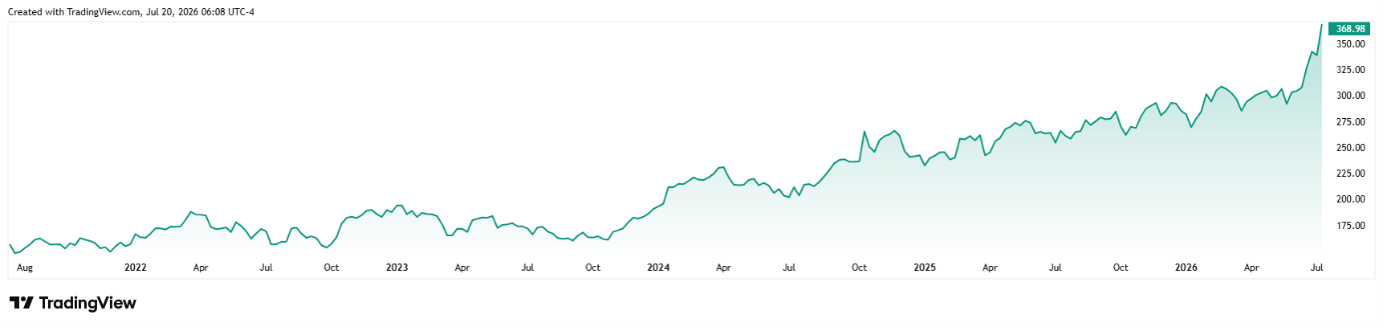
Travelers Companies’ stock price performance over the past five years*
Insurance profitability reached $1.74 billion
One of the most important performance indicators was underwriting profit, which reached $1.738 billion before taxes. In the same period last year, it stood at $1.022 billion, representing a year-over-year increase of $716 million. The combined ratio improved from 90.3% to 83.6%. This figure indicates what portion of the premiums collected the insurance company used to cover claims and operating expenses. The figure of 83.6% means that for every $100 in premiums collected, $83.60 went toward expenses and insurance claims. The remainder represented profit from underwriting operations, before accounting for investment income. The basic combined ratio improved from 84.7% to 84.1%. Travelers also reported a favorable development in reserves from prior years amounting to $578 million, compared to $315 million a year ago. The results thus show that the company was able to price its insurance products appropriately while also building sufficient reserves for future claims. 2
Catastrophic losses fell by $409 million
The decline in losses caused by natural disasters provided a significant boost to profitability. In the second quarter, Travelers reported catastrophic losses of $518 million before taxes, representing a decrease of $409 million from last year’s level of $927 million. Losses during the quarter were primarily due to high winds and hailstorms in several U.S. states. Catastrophic events increased the combined ratio by 4.9 percentage points, whereas a year ago their negative impact was as high as 8.5 percentage points. An even more pronounced difference is evident in the results for the first half of the year. Catastrophic losses totaled $1.279 billion, representing a decrease of $1.914 billion from the $3.193 billion recorded during the first six months of 2025. The lower number and reduced severity of insurance claims were thus among the main reasons for the sharp increase in profits. However, this factor may not be stable, as the results of property and casualty insurers remain heavily dependent on the occurrence of storms, fires, floods, and other natural disasters.2 [2]
The bond portfolio generated $883 million
Another significant source of growth was net investment income, which reached $883 million after taxes and increased by 14% year-over-year from $774 million. Before taxes, investment income totaled $1.070 billion, compared to $942 million a year ago. Travelers attributed this growth to higher average yields on its long-term fixed-income securities portfolio and an increase in the average volume of invested assets. The insurance company collects premiums before it has to pay out on most future claims, allowing it to invest a significant portion of its capital primarily in bonds. Higher interest income therefore gradually increases the company’s recurring revenue. In the first six months of 2026, net investment income after taxes reached $1.716 billion, an increase of approximately 11% year-over-year. At the same time, the company recorded realized investment gains of $48 million after taxes, compared to just $5 million in the same quarter of the previous year.2
$1.58 billion was returned to shareholders
Despite the sharp rise in profit, the growth in premiums written remained significantly more moderate. Net premiums written totaled $11.529 billion, compared to $11.543 billion a year ago. Excluding the impact of the sale of the Canadian operations, premiums written increased by 2% year-over-year. The commercial insurance segment reported net written premiums of $5.984 billion, and the specialty insurance and surety segment grew by 14% to $1.237 billion. The personal insurance segment recorded a decline of 8% to $4.308 billion. Travelers used its strong earnings and robust capital position to return $1.577 billion to shareholders. Of this amount, $1.311 billion was used to repurchase 4.3 million of its own shares at an average price of $304.06 per share. The average diluted number of shares outstanding fell 7% year-over-year from 229.3 million to 213.6 million, which supported growth in earnings per share. At the same time, book value per share rose 21% year-over-year to $158.81, and the board of directors approved a quarterly dividend of $1.25 per share. 2
Conclusion
Travelers Companies is now in a position where its results reflect not only a more favorable trend in catastrophe losses, but also long-term disciplined underwriting, growing investment returns, and effective capital management. The combination of net income of $2.208 billion, a combined ratio of 83.6%, investment income of $883 million, and a return of $1.577 billion to shareholders resulted in one of the strongest quarters in the company’s history. The results also confirm that Travelers can benefit from higher interest income and improving profitability in its insurance portfolio even without significant growth in total revenue. However, future performance will continue to depend on the number of natural disasters, pricing discipline, and the company’s ability to sustain growth in investment income. If Travelers can continue to underwrite policies effectively, manage risks properly, and leverage its strong capital position, the current results may not represent a one-time success but rather a confirmation of long-term sustainable profitability. [3]
[1,2,3] Forward-looking statements are based on assumptions and current expectations, which may be inaccurate, or on the current economic environment, which may change. Such statements are not guarantees of future performance. They involve risks and other uncertainties that are difficult to predict. Actual results may differ materially from those expressed or implied in any forward-looking statements.
* Past performance is no guarantee of future returns.
O.Z.I. Online Zone Investment Opportunities (OZIOS) is a registered trademark of APME FX TRADING EUROPE LTD, a Cyprus Investment Firm (CIF) supervised and regulated by the Cyprus Securities and Exchange Commission (CySEC) under CIF license number 335/17, with a registered address at Lophitis Business Center, Office 404, 4th Floor, 28 October Ave 249, Limassol 3035, Cyprus. Contracts for Difference (CFDs) are complex instruments and carry a high risk of rapid financial loss due to leverage. 81.54% of retail investor accounts lose money when trading CFDs with this provider. You should consider whether you understand how CFDs work and whether you can afford to take the high risk of losing your money.
[1] https://en.wikipedia.org/wiki/The_Travelers_Companies
[2] https://investor.travelers.com/newsroom/press-releases/news-details/2026/Travelers-Reports-Excellent-Second-Quarter-and-Year-to-Date-Results/default.aspx
[3] https://www.reuters.com/legal/litigation/travelers-profit-jumps-lower-catastrophe-losses-strong-investment-income-2026-07-17/