Warning on risks: Financial contracts for difference are complex instruments and are associated with a high risk of rapid financial losses due to leverage. On 77.44% of retail investor accounts, financial losses occur when trading financial contracts for difference with this provider. You should consider whether you understand how financial contracts for difference work, and whether you can afford to take the high risk of suffering financial losses. Please read the Risk Disclosures.

PepsiCo Q2 2026: Revenue Exceeded $24 Billion, but the U.S. Sent Shares Lower
PepsiCo released its results for the second quarter of 2026, which at first glance appeared very impressive. The company managed to exceed market expectations and reaffirm its strong position among the world’s largest food and beverage manufacturers. However, the reaction from investors was surprisingly negative, suggesting that more serious problems lie behind the positive numbers. It is precisely these issues that may determine whether PepsiCo can maintain its growth and shareholder confidence in the coming quarters.
About the company
PepsiCo, Inc. is an American multinational corporation headquartered in Purchase, New York. The company is engaged in the production, marketing, and distribution of beverages and food products. It was founded in 1965 through the merger of Pepsi Cola and Frito Lay. Today, its portfolio includes the Pepsi, Lay’s, Doritos, Cheetos, Gatorade, Mountain Dew, Quaker, and SodaStream brands. Consumers enjoy PepsiCo products more than 1 billion times a day in over 200 countries and territories. In 2025, the company generated revenue of nearly $94 billion, and its shares are traded on the Nasdaq under the symbol PEP.[1]
Numbers that impressed at first glance
PepsiCo reported net sales of $24.18 billion in the second quarter of 2026, representing year-over-year growth of 6.4%. The result also exceeded analysts’ expectations of approximately $23.95 billion. Organic revenue, which excludes the impact of exchange rates, acquisitions, and asset sales, rose by 2.4%. Net income attributable to PepsiCo shareholders rose from $1.26 billion to $2.98 billion, and reported earnings per share increased from $0.92 to $2.18. This significant increase was partly due to the fact that results for the same period last year were weighed down by write-downs of the Rockstar and Be & Cheery brands. Adjusted earnings per share, which rose 4% from $2.12 to $2.20, therefore provide a better picture of underlying performance. Adjusted operating income reached $4.07 billion, up 4% year-over-year. While the results showed continued growth, their breakdown revealed significant differences across the company’s various regions and segments.[2]
North America marred the overall picture
The biggest cause for concern was PepsiCo’s performance in the North American market, where organic revenue fell by 0.5% and fell short of management’s expectations. Revenue for the PepsiCo Foods North America division declined by 2%, primarily due to lower selling prices. Throughout the year, the company cut prices on brands such as Lay’s, Doritos, Cheetos, and Tostitos by up to 15% to win back customers sensitive to rising living costs. However, snack sales volume remained flat in the second quarter. The North American Beverage division reported a 7% increase in revenue, but as much as 6 percentage points of that growth came from acquisitions and asset sales. Its organic revenue grew by only 1%, and sales volume declined by 4%. Management stated that high fuel prices particularly limited impulse purchases at gas stations and smaller stores. PepsiCo therefore plans to offer more affordable package sizes, better value product combinations, and increased marketing investments.2 [1]
International markets became the main driver of growth
Weaker performance in North America was offset by international operations, where organic sales rose by 7%. This marked the 21st consecutive quarter in which PepsiCo achieved organic sales growth of at least the mid-single-digit range internationally. International food sales volume rose by 4%, and beverage sales volume increased by 5%. Globally, food sales volume rose by 3% and beverage sales volume by 2%. Successful markets included Mexico, Colombia, Argentina, India, Germany, Poland, Egypt, Turkey, Saudi Arabia, China, Australia, and Pakistan. Growth in international beverages was driven primarily by the United Kingdom, Brazil, Colombia, and Argentina. Campaigns tied to the 2026 FIFA World Cup also played a significant role, boosting sales of the Lay’s, Tostitos, and Quaker brands. The international business is becoming increasingly important for PepsiCo’s future growth, as approximately 80% of its international revenue comes from developing and fast-growing markets. It is precisely these regions that are currently driving the growth the company is unable to achieve in its domestic market.2
Cheaper products are putting pressure on margins
PepsiCo is trying to restore sales growth through lower prices, increased marketing spending, and an expanded lineup of healthier products, but this strategy is putting pressure on profitability. The adjusted operating margin fell from 17.2% to 16.8%, a decrease of 40 basis points. The greatest pressure was evident in North America, where the company invested in more affordable snack prices while also facing an unfavorable beverage sales mix. Higher input cost inflation could complicate the situation in the second half of the year. PepsiCo specifically highlighted higher costs for commodities, packaging, and logistics. At the same time, rising oil prices are increasing shipping costs and constraining consumer budgets. The company aims to offset some of this pressure through savings from automation, digitization, and operational streamlining. Refunds of tariffs paid in the previous year are also expected to help. However, management also plans to increase spending on advertising and innovation. PepsiCo must thus fund the battle for customers at a time when its production costs are rising and the scope for further price increases remains limited.2[3] [2]
The outlook remained unchanged, and the market punished the company’s caution
Despite a weaker performance in North America, PepsiCo has reaffirmed its full-year 2026 outlook. Organic revenue is expected to grow by 2 to 4 percent, and adjusted earnings per share on a constant currency basis are expected to increase by 4 to 6 percent. Taking into account favorable currency movements and acquisitions, the company expects reported revenue growth of 4 to 6% and adjusted earnings per share growth of 5 to 7%. Capital expenditures are expected to remain below 5% of revenue, and free cash flow conversion is expected to reach at least 80%. PepsiCo plans to return approximately $8.9 billion to shareholders, of which $7.9 billion will go toward dividends and $1 billion toward share buybacks. However, investors had expected a more convincing outlook and a faster recovery in the North American market. As a result, shares fell by about 5% following the earnings release and were headed for their worst trading day since April 2025. The market thus signaled that simply beating expectations was not enough. The key question remains whether PepsiCo can restore domestic demand without further eroding profit margins.23 [3]
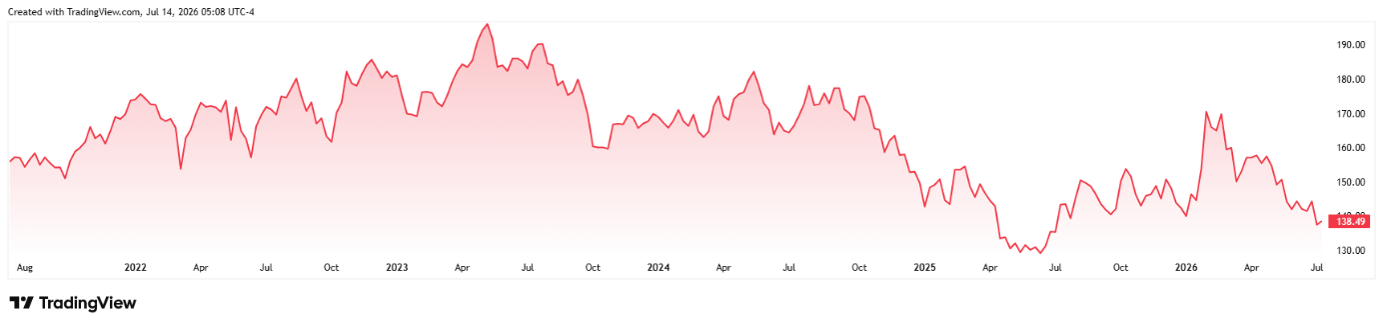
PepsiCo’s stock price performance over the past five years*
Conclusion
PepsiCo now stands at a point where its future growth will depend not only on the strength of its global brands, but primarily on its ability to respond to changing consumer behavior. The combination of weaker demand in North America, rising input costs, price pressure, and continued expansion in international markets creates a challenging environment in which every percentage point of growth and profit margin will matter. The results for the second quarter of 2026 showed that the company is capable of exceeding expectations and maintaining revenue growth, but they also revealed issues that investors cannot ignore. If PepsiCo can restore sales volume in North America, continue strong growth in international markets, and at the same time protect its profitability, the current weaker stock market reaction may be only a temporary hurdle on the path to more stable growth. [4]
[1,2,3,4] Forward-looking statements are based on assumptions and current expectations, which may be inaccurate, or on the current economic environment, which may change. Such statements are not guarantees of future performance. They involve risks and other uncertainties that are difficult to predict. Actual results may differ materially from those expressed or implied in any forward-looking statements.
* Past performance is no guarantee of future returns.
O.Z.I. Online Zone Investment Opportunities (OZIOS) is a registered trademark of APME FX TRADING EUROPE LTD, a Cyprus Investment Firm (CIF) supervised and regulated by the Cyprus Securities and Exchange Commission (CySEC) under CIF license number 335/17, with a registered address at Lophitis Business Center, Office 404, 4th Floor, 28 October Ave 249, Limassol 3035, Cyprus. Contracts for difference (CFDs) are complex instruments and carry a high risk of rapid financial loss due to leverage. 81.54% of retail investor accounts lose money when trading CFDs with this provider. You should consider whether you understand how CFDs work and whether you can afford to take the high risk of losing your money.
[1] https://www.pepsico.com/newsroom/press-releases/2026/pepsico-announces-timing-and-availability-of-first-quarter-2026-financial-results?utm_source=chatgpt.com
[2] https://investors.pepsico.com/docs/pepsico-5v9wci20/media/Files/investors/q2-2026-earnings-release.pdf
[3] https://www.reuters.com/business/pepsico-beats-revenue-estimates-flags-pressure-tighter-consumer-budgets-2026-07-09/