Warning on risks: Financial contracts for difference are complex instruments and are associated with a high risk of rapid financial losses due to leverage. On 77.44% of retail investor accounts, financial losses occur when trading financial contracts for difference with this provider. You should consider whether you understand how financial contracts for difference work, and whether you can afford to take the high risk of suffering financial losses. Please read the Risk Disclosures.


Lennar: Profits Plunge 52%; Expensive Mortgages Weigh on the U.S. Real Estate Market
Results from Lennar, one of the largest U.S. homebuilders, revealed that the situation in the U.S. housing market remains tense. Weaker demand, expensive financing, and more cautious customers are beginning to have an increasingly significant impact on the company’s performance. The latest figures suggest that the pressure on the U.S. housing market may be more severe than it appears at first glance.
About the company
Lennar Corporation is a U.S. company headquartered in Miami, Florida, and is one of the largest builders of single-family homes in the United States. It was founded in 1954 and, since its inception, has built more than 1.5 million homes for customers across the country. The company’s core business is the construction and sale of residential real estate, and through its Financial Services segment, it also provides mortgage financing, title services, and real estate transaction closing services.
Results fell short of expectations
Lennar entered the third quarter of 2026 in an environment that gradually deteriorated over the period, which was fully reflected in its financial results. The company’s total revenue fell year-over-year from $8.81 billion to $8.05 billion, representing a decline of approximately 9%. The market had expected revenue of approximately $8.32 billion. Profitability saw an even more significant decline. The company’s net income reached $284 million, compared to $591 million a year ago. Earnings per share thus fell from $2.29 to $1.19. After adjusting for losses from technology investments and one-time items, earnings per share came in at $1.23, while analysts had expected approximately $1.28. At the same time, operating income for the homebuilding division fell from $760 million to $502 million. The combination of weaker revenue, a significant drop in earnings, and a more cautious outlook failed to impress investors, and Lennar’s stock fell by approximately 3%* in after-hours trading following the release of the results.
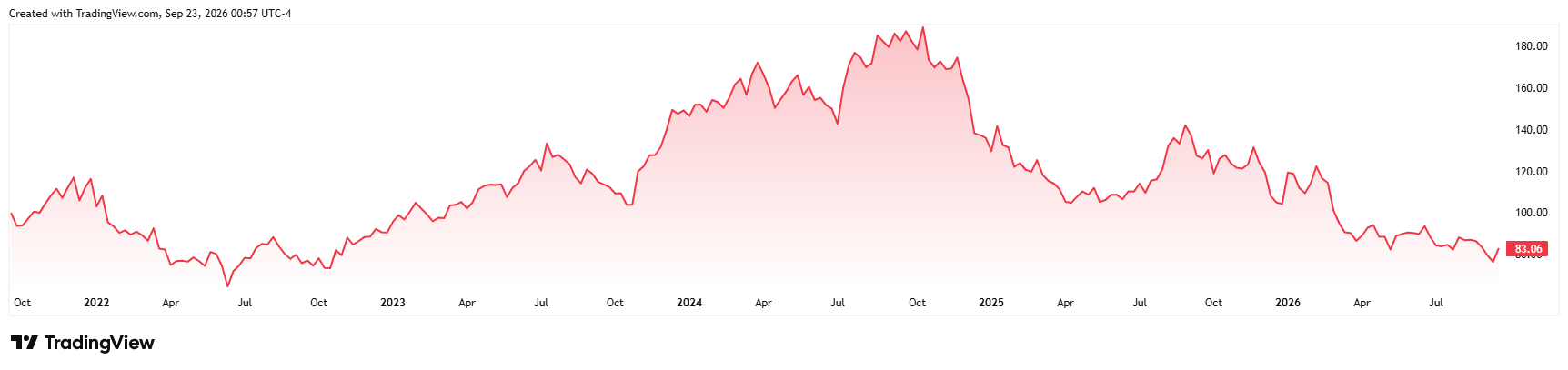
Lennar’s stock price performance over the past five years*
Demand for new homes is waning
The weaker results were not caused solely by accounting items but also by a noticeable cooling of demand for new homes. Lennar received orders for 20,879 homes during the quarter, representing a 9% year-over-year decline from 23,004 homes. The value of new orders decreased from $8.44 billion to approximately $7.50 billion. The company also delivered 20,840 homes to customers, which was 3% less than the 21,584 homes delivered in the same period last year. The value of backorders reached approximately $6.35 billion at the end of the quarter and included 16,857 homes. A year ago, the value of backorders was $6.65 billion, representing 16,953 homes. During the quarter, Lennar operated 1,713 active communities, up from 1,664 communities a year ago. The company thus increased the number of locations where it offers its homes, but despite its broader sales network, it recorded a noticeable decline in new orders. Order trends are among the key indicators of future revenue and suggest that weaker demand may affect financial performance in the coming quarters as well.2 [1]
Discounts are propping up sales, but margins are suffering
Lennar is attempting to respond to weaker demand with a more aggressive pricing strategy and generous incentives for customers. The average sales price of homes delivered during the third quarter reached $372,000, down 3% from $383,000 a year ago. The company also noted that the average price included incentives amounting to approximately 12% of the home’s value. These may include mortgage assistance, price adjustments, or other forms of sales support. This strategy helps Lennar maintain sales volume, but it also puts pressure on its profitability. The gross margin on home sales fell year-over-year from 17.5% to 15.8%, and gross profit from this segment decreased from approximately $1.4 billion to $1.2 billion. Selling, general, and administrative expenses totaled $714 million, representing 9.2% of home sales revenue. A year ago, this ratio stood at 8.2%. At the same time, Lennar managed to reduce construction costs per square foot by 6% year-over-year and shorten the average construction time from 126 to a record 116 days. However, these savings have not yet fully offset lower sales prices and the costs associated with stimulating demand.2
Mortgages are once again putting pressure on buyers
Lennar’s main challenge remains housing affordability, which is once again being exacerbated by rising financing costs. Company management reported that the 30-year mortgage rate stood at approximately 6.8% at the end of the quarter and continued to rise after the period ended. Data from Freddie Mac subsequently showed that the average rate on a 30-year fixed-rate mortgage reached 6.95% on September 17, 2026, while just a week earlier it stood at 6.76%. This situation is not unique to Lennar. The National Association of Home Builders’ U.S. Home Builders’ Confidence Index fell to 32 points in September, the lowest level in the past 12 months. As many as 38% of the builders surveyed reported that they had lowered prices, and 66% were using various incentives to boost sales. Lennar also pointed to a decline in consumer confidence and noted that some buyers are postponing their decision to purchase a home. Higher interest rates not only increase the total cost of buying a home but also directly raise monthly mortgage payments, thereby limiting the number of households able to finance the purchase of a new home.
Lennar lowers full-year outlook
Deteriorating conditions have forced Lennar’s management to revise its expectations for the remainder of the fiscal year as well. The company no longer expects to deliver 82,000 to 83,000 homes for the full year, as it had projected after the second quarter. The new target has been lowered to approximately 80,000 to 81,000 homes. In the fourth quarter alone, the company expects new orders in the range of 19,500 to 20,500 homes and the delivery of 22,000 to 23,000 properties. The average selling price is expected to range between $370,000 and $380,000, and the gross margin on home sales is projected to reach approximately 15.5% to 16%. Lennar is also working to maintain financial flexibility. At the end of the quarter, it held approximately $1.2 billion in cash, repaid $400 million in bonds, and repurchased 3 million of its own shares for $256 million. The company is also continuing its strategy of reducing its land holdings. Of the approximately 488,000 building lots it owned or controlled, less than 2.5% were held directly on its balance sheet. Thus, despite a weaker market, management is continuing its strategy of maintaining construction volume, controlling costs, and reducing capital tied up in land.2 [2]
Conclusion
Lennar currently operates in an environment where its results are influenced not only by demand for new homes but, more significantly, by high mortgage rates, reduced housing affordability, and growing pressure for price incentives. The company is striving to maintain sales volume through lower prices, more efficient construction, and limiting capital tied up in land, but these measures have not yet been able to prevent a decline in profitability and margins. The results for the third quarter of 2026 therefore show that Lennar remains sensitive to changes in interest rates and consumer demand. If financing conditions improve in the coming quarters and housing affordability begins to recover, the company may benefit from its scale, strong market position, and ability to respond quickly to changes in demand. [3]
* Past performance is no guarantee of future results.
[1,2,3] Forward-looking statements are based on assumptions and current expectations, which may be inaccurate, or on the current economic environment, which may change. Such statements are not guarantees of future performance. They involve risks and other uncertainties that are difficult to predict. Actual results may differ materially from those expressed or implied in any forward-looking statements.
O.Z.I. Online Zone Investment Opportunities (OZIOS) is a registered trademark of APME FX TRADING EUROPE LTD, a Cyprus Investment Firm (CIF) supervised and regulated by the Cyprus Securities and Exchange Commission (CySEC) under CIF license number 335/17, with a registered address at Lophitis Business Center, Office 404, 4th Floor, 28 October Ave 249, Limassol 3035, Cyprus. Contracts for difference (CFDs) are complex instruments and carry a high risk of rapid financial loss due to leverage. 77.44% of retail investor accounts lose money when trading CFDs with this provider. You should consider whether you understand how CFDs work and whether you can afford to take the high risk of losing your money.
[1] https://en.wikipedia.org/wiki/Lennar
[2] https://investors.lennar.com/press-releases/2026/09-16-2026-213038087
[3] https://www.freddiemac.com/pmms/pmms_archives
[4] https://www.reuters.com/business/us-homebuilder-sentiment-drops-12-month-low-september-2026-09-16/