Warning on risks: Financial contracts for difference are complex instruments and are associated with a high risk of rapid financial losses due to leverage. On 71.07% of retail investor accounts, financial losses occur when trading financial contracts for difference with this provider. You should consider whether you understand how financial contracts for difference work, and whether you can afford to take the high risk of suffering financial losses. Please read the Risk Disclosures.


General Dynamics: Nearly $99 billion in new orders in a single quarter
On October 30, General Dynamics released results that drew attention to the scale of its new defense contracts. Revenue for the third quarter of 2026 rose 12.9% year-over-year to $14.6 billion, but even more striking was the backlog of orders totaling $220.3 billion, driven by large submarine contracts. Can the U.S. company translate growing demand into higher long-term profitability?
About the company
General Dynamics Corporation is a U.S. publicly traded company headquartered in Reston, Virginia. Founded in 1952, it operates in the defense and aerospace industries. Its business encompasses four main areas: aviation, naval systems, combat systems, and technologies. Among its best-known products are Gulfstream aircraft, Abrams tanks, Stryker armored vehicles, and Virginia- and Columbia-class submarines. It employs more than 117,000 people worldwide and reported revenue of $52.6 billion in 2025. The company’s stock is traded on the New York Stock Exchange under the ticker symbol GD.[1]
Profits grew faster than revenue
In the third quarter of 2026, which ended on October 4, General Dynamics reported revenue of $14.566 billion, representing year-over-year growth of 12.9%. Net income increased from $1.059 billion to $1.229 billion, or 16.1%. Diluted earnings per share rose from $3.88 to $4.49. The company also improved its operating margin from 10.3% to 10.5%, and operating income reached $1.527 billion. Sales growth was thus accompanied by an improvement in overall profitability. For the first nine months of the year, the company reported revenue of $42.141 billion and net income of $3.514 billion. The strong quarter therefore continued the growth the company had already achieved during the first half of the year.[2]
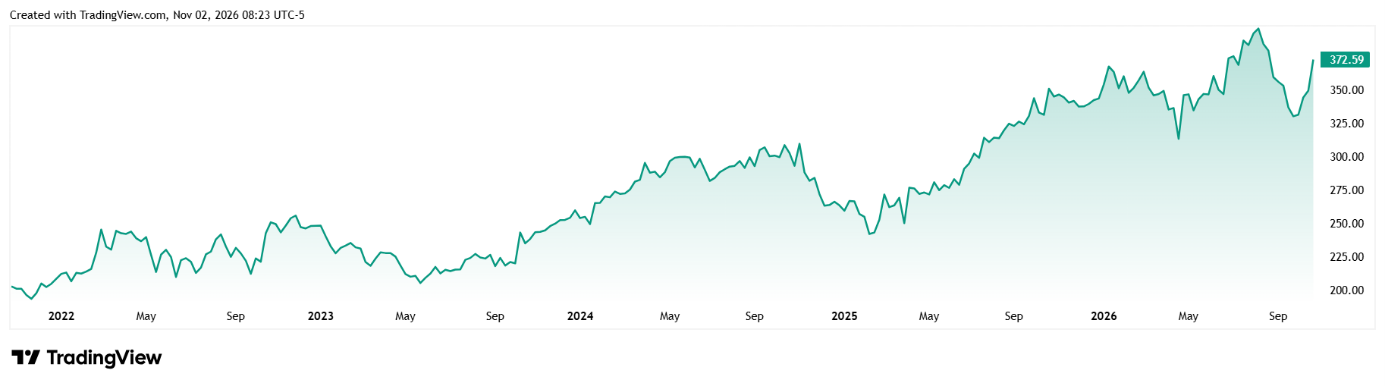
General Dynamics Stock Price Performance Over the Past Five Years*
Submarine contracts significantly boosted orders
The most striking figure in the results was new orders totaling $98.8 billion, a value representing approximately 6.8 times quarterly revenue. The defense divisions secured contracts worth $93.8 billion, and the aerospace division secured approximately $5 billion. A significant portion of this came from Electric Boat’s submarine contracts, which were announced on July 29. These include $29.5 billion for five additional Columbia-class submarines and $42.1 billion for nine Virginia-class submarines. General Dynamics’ total backlog at the end of the quarter reached $220.3 billion. This figure represents the scope of contracted work that the company has yet to complete. Orders will therefore be gradually recognized as revenue as individual programs are completed and do not, in and of themselves, represent profit already earned.2 [1]
All four divisions reported higher revenue
The Marine Systems division grew the fastest, with revenue increasing by 21.1% to $4.96 billion. Its operating profit rose by 34.4% to $391 million, and the margin reached 7.9%. The Aerospace division increased revenue by 9.3% to $3.536 billion, and operating profit reached $513 million with a margin of 14.5%. The Technology division reported revenue of $3.684 billion, up 10.8% year-over-year. However, this growth did not translate into improvements across all metrics. While the Combat Systems division increased revenue by 6% to $2.386 billion, its operating profit fell from $335 million to $330 million. The results thus highlight the varying ability of individual business segments to convert higher sales into profit.2
Cash flow supported both investments and debt repayment
Operating cash flow reached $1.71 billion, compared to $2.109 billion a year ago. At the same time, capital expenditures rose from $212 million to $481 million. After deducting these expenses, free cash flow stood at $1.229 billion, compared to $1.897 billion a year ago. Thus, despite profit growth, quarterly cash generation declined year-over-year. However, for the first nine months, free cash flow increased from $3.007 billion to $4.827 billion. During the quarter, the company paid dividends totaling $429 million and reduced its total debt by $500 million. At the end of the period, it had approximately $4.4 billion in cash and total debt of approximately $7 billion.2
The higher outlook is accompanied by execution and legal risks
Management raised its full-year diluted earnings per share guidance from a range of $16.80 to $16.90 to $17.20 to $17.30. It expects 2026 revenue to be between $56.5 billion and $56.8 billion, with an operating margin of approximately 10.5%. Future performance will also depend on the expansion of production capacity, workforce availability, and supplier reliability. In its quarterly report, the company also stated that the U.S. Securities and Exchange Commission (SEC) and the Civil Division of the Department of Justice are investigating the accounting for Electric Boat’s submarine contracts. General Dynamics is cooperating with the investigation and is currently unable to estimate the outcome or any potential financial loss. The growing order volume must therefore be evaluated in conjunction with the company’s ability to meet production schedules, control costs, and manage these uncertainties.[3] [2]
Conclusion
General Dynamics has had a strong quarter, in which revenue and profit growth were accompanied by a significant expansion of orders. Its backlog of $220.3 billion illustrates the scope of contracted work, particularly in submarine programs. The raised full-year outlook also reflects management’s positive expectations. However, converting these contracts into revenue, profit, and cash will depend on production capacity, suppliers, and cost control. The year-over-year decline in quarterly free cash flow and the uncertainty surrounding the investigation into Electric Boat’s contract accounting also remain significant factors in the company’s valuation. If General Dynamics can reliably execute orders, effectively scale up production, and maintain financial discipline, current demand could support its business in the coming years. [3]
* Past performance is no guarantee of future results.
[1,2,3] Forward-looking statements are based on assumptions and current expectations, which may be inaccurate, or on the current economic environment, which may change. Such statements are not guarantees of future performance. They involve risks and other uncertainties that are difficult to predict. Actual results may differ materially from those expressed or implied in any forward-looking statements.
O.Z.I. Online Zone Investment Opportunities (OZIOS) is a registered trademark of APME FX TRADING EUROPE LTD, a Cyprus Investment Firm (CIF) supervised and regulated by the Cyprus Securities and Exchange Commission (CySEC) under CIF license number 335/17, with a registered address at Lophitis Business Center, Office 404, 4th Floor, 28 October Ave 249, Limassol 3035, Cyprus. Contracts for Difference (CFDs) are complex instruments and carry a high risk of rapid financial loss due to leverage. 71.07% of retail investor accounts lose money when trading CFDs with this provider. You should consider whether you understand how CFDs work and whether you can afford to take the high risk of losing your money.
[1] https://en.wikipedia.org/wiki/General_Dynamics
[2] https://www.sec.gov/Archives/edgar/data/40533/000004053326000038/gd-20261004.htm
[3] https://stockanalysis.com/stocks/gd/transcripts/718470-q3-2026/