Warning on risks: Financial contracts for difference are complex instruments and are associated with a high risk of rapid financial losses due to leverage. On 77.44% of retail investor accounts, financial losses occur when trading financial contracts for difference with this provider. You should consider whether you understand how financial contracts for difference work, and whether you can afford to take the high risk of suffering financial losses. Please read the Risk Disclosures.

Dell: A 32% surge in stock price confirms that the AI server boom is continuing
On Friday, May 29, 2026, financial markets woke up to news that took investors’ breath away worldwide. Something big had just happened to a stock that many people considered just another tech company from the past decade. The market reacted so violently that questions arose as to whether we were witnessing the awakening of a giant that had quietly become a key player in the greatest technological revolution of our time. Something has changed in Dell’s results, and that something is more powerful than anyone imagined. The numbers reflecting this development are changing our perspective on where we currently stand in the AI investment cycle.
About the Company
Dell Technologies Inc. is an American multinational technology company headquartered in Round Rock, Texas, that develops, operates, and sells computer hardware, servers, storage systems, networking solutions, and related services. The company was founded in 1984 by Michael Dell as the Original PC Company and today employs more than 120,000 people worldwide. Dell is one of the world’s largest manufacturers of personal computers, and in 2026, it became one of the leading suppliers of AI infrastructure for both corporate and cloud data centers.[1]
The AI server boom is transforming the essence of Dell
Quarterly results released on May 28, 2026, showed that Dell achieved record revenue of $43.8 billion, representing year-over-year growth of 88%. Revenue from AI servers reached $16.1 billion, a 757% increase compared to the same quarter last year. The company’s overall infrastructure division generated revenue of $29 billion, an 181% increase. Shares responded with the largest one-day jump since the company’s return to the stock market in 2018, rising by 32.76%.* This demonstrates that the AI investment cycle is not just about chips, but also about the companies that supply the physical infrastructure for data centers.[2]
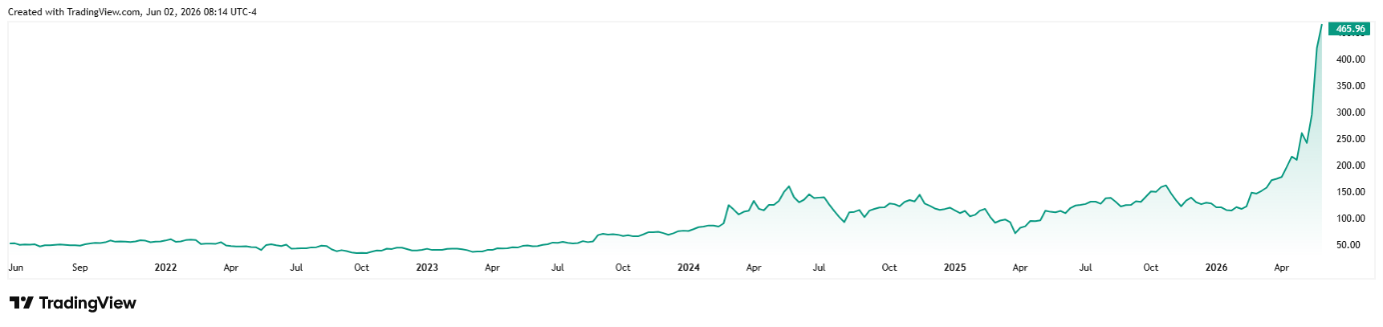
Dell’s stock price performance over the past five years*
It’s not just about computers from the past decade
Over the past two years, Dell has transformed from a personal computer manufacturer into a key supplier of AI infrastructure for the enterprise sector. The Client Solutions Group generated revenue of $14.6 billion, up 17%, while the commercial segment of this division reached a record $13 billion, up 18%. Despite this solid result, it is clear that the focus of growth has shifted dramatically toward servers and infrastructure. Storage revenue reached $4.3 billion, up 8%, and Traditional Servers and Networking generated $8.5 billion, up 92%. Dell is thus no longer a one-dimensional company, but a platform growing across all segments simultaneously.[3]
The market values real numbers, not promises
Dell’s profitability grew just as significantly as its revenue, which is an even more important signal for investors. Diluted EPS reached $5.24, representing a 282% increase compared to the same quarter of the previous year. Non-GAAP diluted EPS reached $4.86, with growth of 214%. Operating profit for the Infrastructure division reached $3.1 billion, a 206% increase, and operating profit for the Client Solutions division reached $1.2 billion, a 79% increase. The company also generated $4.1 billion in operating cash flow in the first quarter and returned $2.1 billion to shareholders through share buybacks and dividends.3
The future of growth is in the 2027 budget
Dell has released a forecast that exceeds analysts' expectations across all key metrics. For the second quarter of FY27, the company forecasts revenue of between $44 billion and $45 billion, which, based on the midpoint of $44.5 billion, represents 49% year-over-year growth. For the full fiscal year 2027, Dell forecasts revenue between $165 billion and $169 billion, which, at the midpoint of $167 billion, represents 47% growth compared to the previous year. Most significant is the outlook for AI servers, where the company has raised its forecast to approximately $60 billion annually, representing a 144% year-over-year increase. Total GAAP diluted EPS for the full year is expected to reach $17.31, a 99% increase.3 [1]
The tech boom is spreading across the entire supply chain
Dell’s results are important not only for the company itself but also for understanding the current phase of the AI investment cycle. Dell recorded $24.4 billion in new AI orders in a single quarter, a figure that demonstrates that demand from enterprises and data centers continues to accelerate. The market has thus received clear evidence that the AI boom is not turning into a bubble but rather moving into a phase of real multi-billion-dollar contracts that are integrating AI infrastructure into companies’ day-to-day operations. Wall Street responded to these results with broader gains, with the technology sector driving the indices higher.* Dell has thus definitively joined Nvidia and other AI leaders as a company indispensable to the physical construction of AI infrastructure, and its results have become a barometer for the entire AI infrastructure cycle.3
Conclusion
Dell now stands at a point where its market story no longer hinges on its past in the personal computer segment, but on its ability to convert AI infrastructure demand into concrete revenue, profit, and new multi-year orders. The latest results showed that AI server growth for the company has moved from promises to a phase of actual monetization, which is a more significant signal for investors than the rhetoric surrounding artificial intelligence itself. If Dell maintains its order growth momentum, expands its customer base, and meets its outlook of approximately $50 billion in AI server revenue by fiscal year 2027, it can definitively rank among the major winners of the next phase of AI capital expenditures. For the market, therefore, Dell represents not only a successful quarterly surprise but also proof that the AI investment cycle is increasingly relying on companies that supply critical infrastructure for data centers and enterprise deployments. [2]
[1,2] Forward-looking statements are based on assumptions and current expectations that may prove inaccurate, or on the current economic environment, which may change. Such statements are not guarantees of future performance. They involve risks and other uncertainties that are difficult to predict. Actual results may differ materially from those expressed or implied in any forward-looking statements.
* Past performance is no guarantee of future returns.
O.Z.I. Online Zone Investment Opportunities (OZIOS) is a registered trademark of APME FX TRADING EUROPE LTD, a Cyprus Investment Firm (CIF) supervised and regulated by the Cyprus Securities and Exchange Commission (CySEC) under CIF license number 335/17, with a registered address at Lophitis Business Center, Office 404, 4th Floor, 28 October Ave 249, Limassol 3035, Cyprus. Contracts for difference (CFDs) are complex instruments and come with a high risk of rapid financial loss due to leverage. 81.54% of retail investor accounts lose money when trading CFDs with this provider. You should consider whether you understand how CFDs work and whether you can afford to take the high risk of losing your money.
[1] https://en.wikipedia.org/wiki/Dell
[2] https://www.cnbc.com/2026/05/29/dell-stock-earnings-ai-servers.html
[3] https://investors.delltechnologies.com/static-files/ef369f17-2b83-4fd4-9a37-6b6ab53ac9c5