Warning on risks: Financial contracts for difference are complex instruments and are associated with a high risk of rapid financial losses due to leverage. On 77.44% of retail investor accounts, financial losses occur when trading financial contracts for difference with this provider. You should consider whether you understand how financial contracts for difference work, and whether you can afford to take the high risk of suffering financial losses. Please read the Risk Disclosures.

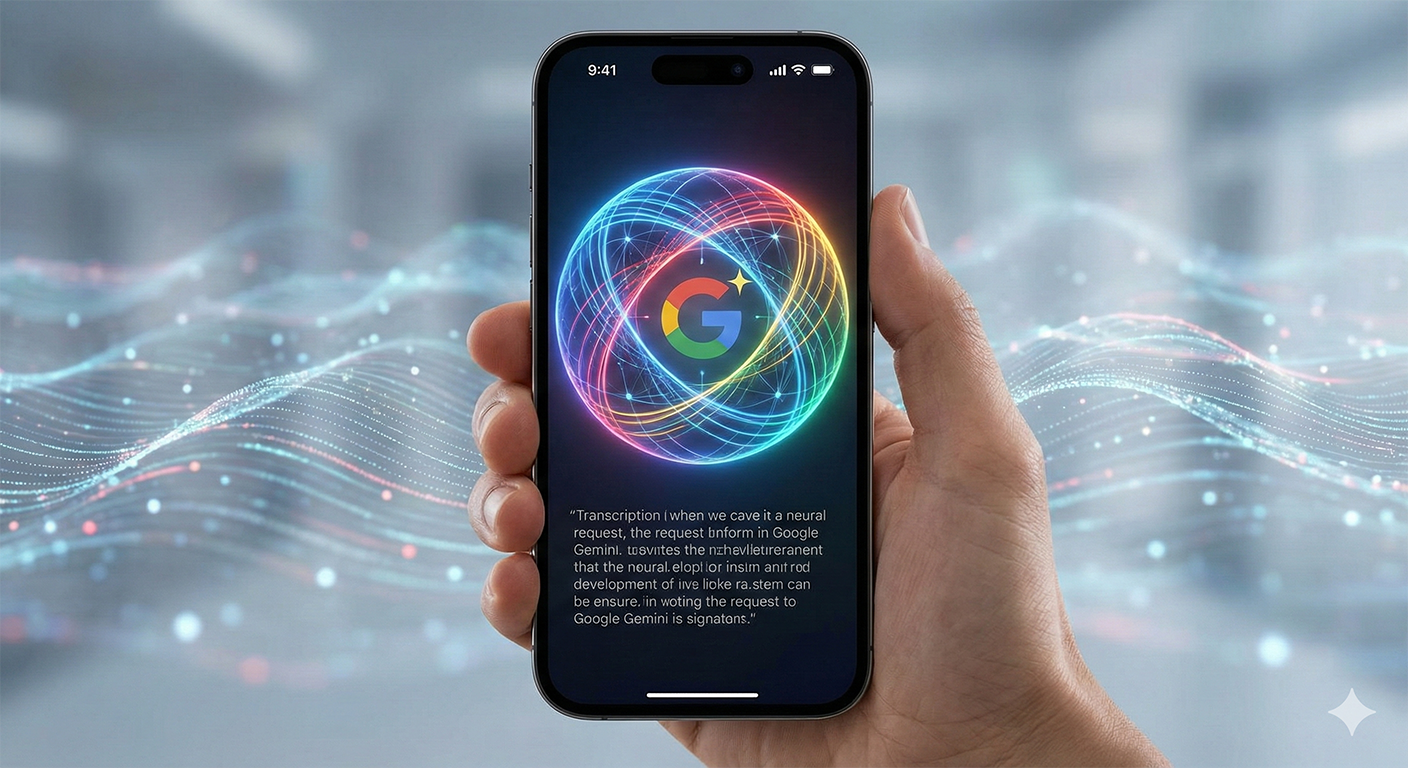
Apple bets on Google: Gemini will become the brain of the new Siri
About the company
Apple Inc. is an American publicly traded technology company headquartered in Cupertino, California. It was founded on April 1, 1976, by Steve Jobs, Steve Wozniak, and Ronald Wayne. Key products include iPhone, iPad, Mac, Apple Watch, and other devices, and a significant part of growth is driven by services such as the App Store, iCloud, and subscription services. In fiscal year 2025, which ended on September 27, 2025, Apple reported revenue of $416 billion, net income of $112 billion, and employed approximately 166 thousand people.[1]
Multi-year deal with Google
On January 12, 2026, Apple announced a multi-year collaboration with Google, in which the Gemini models will become the foundation for the next generation of Apple Foundation Models and will also support future Apple Intelligence features. For Apple, it is important that this is not a peripheral integration of a single app, but a change to the core layer of artificial intelligence in the ecosystem, which is also to rely on Google’s cloud technology. The partnership comes at a time when Apple needs to accelerate the delivery of artificial intelligence features and reduce the risk of further schedule shifts, with the result expected to appear in products used on more than two billion active devices. Both companies also confirmed that the selection of Gemini followed an evaluation of the capabilities of available solutions, which suggests that this time, Apple is betting on performance and scaling in production.[2]
Siri in 2026 should be more personalized
The most visible impact of the deal is expected to be a redesigned Siri, which Apple plans to deploy during 2026 and which is to be significantly more personalized. Importantly, Apple is directly linking Siri with Apple Intelligence in its messaging, making it a central element of the user experience across devices and services. In the context of previous steps, this is also a change compared to 2024, when Apple integrated ChatGPT into Siri, while the new model is to move Gemini into the position of the main foundation and leave ChatGPT more as an optional support for more demanding queries. Such a shift increases the likelihood that Apple will be able to expand features such as summarization, context understanding, and intelligent actions in apps more quickly, without waiting only for internal development of its own models in each new version.[3]
Privacy remains at the core
In the announcement, Apple emphasized that the new capabilities are to preserve its privacy protection standards, which is critical, especially for Siri personalization and working with sensitive user context. The practical significance lies in the statement that Apple Intelligence is to continue running primarily on-device and via Private Cloud Compute, allowing Apple to retain control over where computations are performed and what data is processed off the device. On the other hand, with this approach, Apple reduces reputational risk in the mass deployment of artificial intelligence, since these are features intended for hundreds of millions of users while also protecting a strategic advantage built on privacy. At the same time, this suggests that the deal with Google is not about handing over the entire process to foreign infrastructure, but about combining Gemini models with an architecture that Apple wants to operate under its own rules.2
Competitive pressure forced Apple to choose a faster path
The collaboration with Google shows that in 2026, Apple prioritized speed and practical availability of features over purely internal development, because the market is already comparing assistant quality across platforms and competitors are introducing new capabilities in shorter cycles. AP notes that Apple has lagged in recent years in the pace of deploying AI features, and the redesign of Siri was pushed out to 2026, which increases pressure for the result to feel like a significant leap rather than a cosmetic update. For Apple, it is also important that the deal with Google reduces technological risk in scaling, but it raises questions about future negotiating position when the core intelligence of the voice assistant relies on external models. At the same time, it is also a signal for the entire sector that the fight for the distribution of artificial intelligence is shifting directly into the system layers of phones and operating ecosystems.[4]
Apple connects even more with Google
The announcement of the deal immediately influenced investor expectations because it confirmed that Apple had chosen one of the strongest players in artificial intelligence models for a key modernization of Siri, and the market also assessed the strengthening of Google as significant. On January 12, 2026, Alphabet closed above a market value of $4 trillion for the first time, and the move was tied precisely to the news about AI collaboration with Apple, with Alphabet shares closing at $331 and reaching $334 during the day.* For Apple, however, the regulatory dimension is equally important, since the deal comes alongside an existing search partnership in which, according to AP, Google pays Apple more than $20 billion a year for the position of the default search engine. The combination of search and artificial intelligence within one relationship increases regulator attention and, at the same time, gives Apple a strong technological injection in the short term, but in the long term also a greater dependence on a single partner in two strategic layers of the product experience.4
Conclusion
Apple has reached a point where the success of Apple Intelligence stops being a marketing add-on and becomes the core of the competitiveness of the entire ecosystem. The multi-year deal with Google and the deployment of Gemini into the redesigned Siri is a decision intended to speed up the delivery of features while protecting the brand through an emphasis on on-device processing and private cloud. The market has already shown that it views this step as fundamental, when Alphabet, after the announcement, closed above four trillion dollars and thereby highlighted the value of control over a distributed AI layer in billion-user ecosystems. For Apple, it will be decisive whether in 2026 Siri delivers a measurable leap in practical usability and whether it can maintain a balance between the speed of innovation, privacy protection, and strategic independence, because these three factors will determine whether the deal with Google proves to be the fastest path to leadership or the beginning of a new dependence in the decade’s most important technological layer.[1]
* Data relating to the past is not a guarantee of future returns.
[1] Forward-looking statements are based on assumptions and current expectations that may be inaccurate, or on the current economic environment, which may change. Such statements are not a guarantee of future performance. They include risks and other uncertainties that are difficult to predict. Results may differ materially from results expressed or implied in any forward-looking statements.
[1] https://www.sec.gov/Archives/edgar/data/320193/000032019325000079/aapl-20250927.htm
[2] https://www.reuters.com/business/google-apple-enter-into-multi-year-ai-deal-gemini-models-2026-01-12/
[3] https://blog.google/company-news/inside-google/company-announcements/joint-statement-google-apple/
[4] https://apnews.com/article/apple-google-artificial-intelligence-partnership-865dfa575279c292bc729a2dfa4e1583