Warning on risks: Financial contracts for difference are complex instruments and are associated with a high risk of rapid financial losses due to leverage. On 77.44% of retail investor accounts, financial losses occur when trading financial contracts for difference with this provider. You should consider whether you understand how financial contracts for difference work, and whether you can afford to take the high risk of suffering financial losses. Please read the Risk Disclosures.

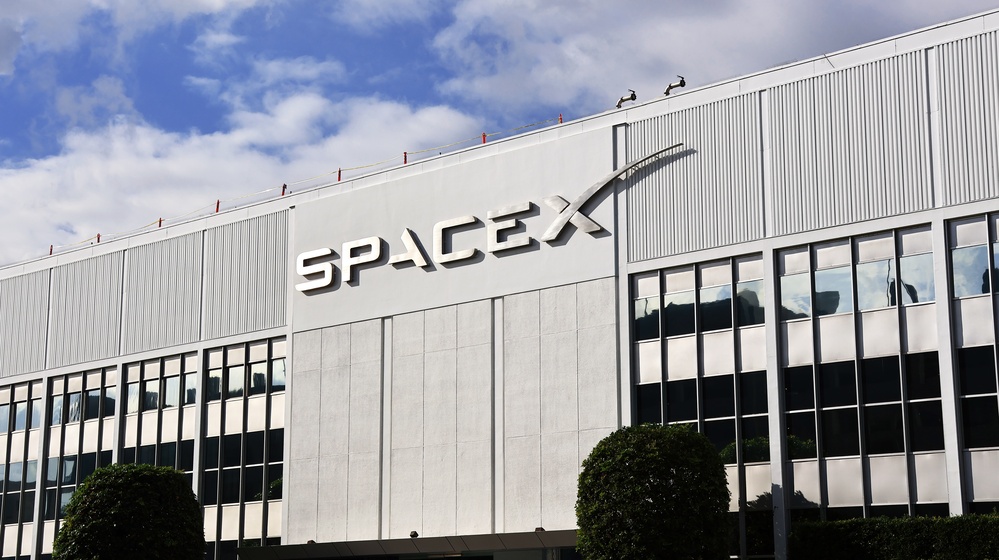
The largest IPO in history is approaching: SpaceX is going public with a valuation of over $2 trillion!
In early April 2026, news shook the financial world. SpaceX, Elon Musk’s space company, filed confidential registration documents with the U.S. Securities and Exchange Commission to conduct an initial public offering. According to sources familiar with the transaction, the company’s target valuation exceeds $2 trillion, and the offering itself could raise up to $75 billion, making this IPO the largest stock market debut in history.
About the Company
Space Exploration Technologies Corp., known as SpaceX, is a U.S. private company headquartered in Texas. It is a company engaged in the development of space technologies, launch vehicles, and satellite communication systems. Elon Musk founded it on March 14, 2002, in El Segundo, California, with an initial personal investment of $100 million and the primary goal of reducing the cost of spaceflight and enabling the long-term colonization of Mars.[1]
Financial performance that surprised Wall Street
SpaceX closed out 2025 with revenue of $15 to $16 billion and net income of approximately $8 billion, representing an operating margin of around 50%. Such profitability is exceptional not only in the context of the space industry but also compared to most technology companies listed on stock markets. By comparison, NASA’s annual revenue is around $25 billion, yet NASA is not a for-profit entity. SpaceX achieved these figures as a fully private company with no obligation to disclose its results, meaning that any information that gets out comes from verified sources with direct access to internal data. The company’s revenue is growing at a significant pace. In 2023, revenue was around $9 billion, meaning that in two years, SpaceX increased its revenue by nearly 75%. This growth rate, combined with high margins, is exactly what professional investors look for when deciding to allocate capital to growth stocks.[2]
A satellite network that is changing the rules of the market
Starlink, SpaceX’s satellite internet division, is today one of the fastest-growing telecommunications projects in the world. As of December 2025, the number of active subscribers reached 9.2 million across 155 countries, with more than 20,000 new users joining daily. This growth rate is remarkable in part because Starlink covers areas where traditional terrestrial networks are unavailable, effectively making it a monopoly in the satellite broadband internet segment. In 2024, Starlink accounted for more than 63% of SpaceX’s total revenue, and this share is expected to grow further in 2026, as the company plans to expand direct mobile coverage for smartphones without the need for special antennas. In 2025, Starlink also launched a service for direct satellite connectivity via mobile devices in partnership with operators like T-Mobile, opening up a market of an estimated 3 billion people who currently lack reliable mobile coverage. This segment alone represents an addressable market worth hundreds of billions of dollars.[3]
A rocket that redefines space logistics
Starship, the largest rocket in human history, is at the heart of SpaceX’s long-term strategy. Standing 122 meters tall and with a low-Earth orbit payload capacity exceeding 100 tons, Starship is designed as a fully reusable system, a revolutionary step in the space industry. Each Falcon 9 flight currently costs an estimated $67 million, while SpaceX states that the target cost per Starship flight is expected to drop below $10 million once full operational capacity is achieved. NASA has selected Starship as the primary lunar lander for the Artemis program, which aims to return humans to the Moon. In addition, in a study from April 2026, scientists demonstrated that Starship could reduce the flight time of a probe to Uranus by 50% compared to current solutions, making it a key tool for deep-space scientific missions as well. The next planned test flight in 2026 is intended to verify the reusability of both rocket stages, which would be the final critical milestone before the start of commercial operations.[4]
Space Data Centers and AI
In addition to existing sources of revenue, increasing attention is being focused on the potential of orbital data centers, that is, computing infrastructure located directly in space. In April 2026, technology analysts published reports suggesting that such solutions could be one of the key drivers behind SpaceX’s valuation exceeding $2 trillion. The idea is that the Starlink satellite network, with thousands of nodes in low Earth orbit, can serve not only for data transmission but also for processing data directly in space, which would significantly reduce latency and energy consumption for artificial intelligence applications. Energy costs for ground-based data centers are currently one of the biggest limiting factors for the growth of the AI industry, whereas solar energy in space is continuous and available without the need to build ground infrastructure. Elon Musk has indicated that SpaceX is actively exploring ways to connect the Starlink network with computing capabilities, which would create an entirely new revenue stream not currently included in any of the company’s conservative financial models.[5]
A Historic Opportunity for Investors
In early April 2026, Bloomberg confirmed that SpaceX had filed a confidential IPO registration statement with the U.S. Securities and Exchange Commission (SEC), which is the standard first step before going public. The target valuation is over $2 trillion, and the planned debut date is June 2026, with the primary offering potentially reaching up to $75 billion. It is important for investors to understand why this IPO is different from most others. SpaceX is not going public because it needs capital to cover operating losses. It is going public as a profitable company with proven revenue streams, a dominant position in the industry, and a portfolio of technologies that no other company in the world possesses. According to analysts, with an initial valuation of $2 trillion and projected revenue growth, SpaceX’s stock could realistically reach a valuation exceeding $5 trillion by 2030, making the company one of the three most valuable in the world. For investors who want to be in on it from the start, this IPO is likely the most significant opportunity since Amazon or Google went public[6] [1].
Conclusion
SpaceX is entering a decisive phase of its development as a company that is no longer built solely on a bold vision but also on tangible results, as, according to available information, it is heading toward an IPO with a valuation exceeding $2 trillion and, at the same time, achieved revenue of approximately $15 to $16 billion and profit of around $8 billion in 2025. The outlook for the coming years, therefore, looks exceptionally strong, as SpaceX holds three key pillars of further growth: a dominant position in rocket launches, the rapidly growing Starlink with over 9.2 million customers in 155 countries, and the technological potential of Starship, which could fundamentally transform the economics of space transportation. It is precisely this combination of a stable business, global expansion, and projects with enormous future impact that increases the likelihood that SpaceX will be increasingly viewed by investors as a strategic infrastructure company of the new era, not merely as a rocket manufacturer. If the company confirms further growth in Starlink, progress in the Starship program, and the ability to open up new segments around data and AI infrastructure in the coming quarters, today’s valuation may not represent a peak, but rather the beginning of an even more significant growth trajectory.
O.Z.I. Online Zone Investment Opportunities (OZIOS) is a registered trademark of APME FX TRADING EUROPE LTD, a Cyprus Investment Firm (CIF) supervised and regulated by the Cyprus Securities and Exchange Commission (CySEC) under CIF license number 335/17, with a registered address at Lophitis Business Center, Office 404, 4th Floor, 28 October Ave 249, Limassol 3035, Cyprus. Contracts for Difference (CFDs) are complex instruments and come with a high risk of losing money rapidly due to leverage. 76.44% of retail investor accounts lose money when trading CFDs with this provider. You should consider whether you understand how CFDs work and whether you can afford to take the high risk of losing your money.
[1] Forward-looking statements are based on assumptions and current expectations, which may be inaccurate, or on the current economic environment, which may change. Such statements are not guarantees of future performance. They involve risks and other uncertainties that are difficult to predict. Actual results may differ materially from those expressed or implied in any forward-looking statements.
[1]https://pestel-analysis.com/blogs/brief-history/spacex
[2]https://www.reuters.com/business/finance/spacex-generated-about-8-billion-profit-last-year-ahead-ipo-sources-say-2026-01-30/
[3]https://www.businessinsider.com/spacex-starlink-customer-numbers-surge-9-million-elon-musk-ipo-2025-12
[4]https://www.sciencedaily.com/releases/2026/04/260402042759.htm
[5]https://techcrunch.com/2026/04/05/can-orbital-data-centers-help-justify-a-massive-valuation-for-spacex/
[6]https://www.bloomberg.com/news/articles/2026-04-01/spacex-is-said-to-file-confidentially-for-ipo-ahead-of-ai-rivals